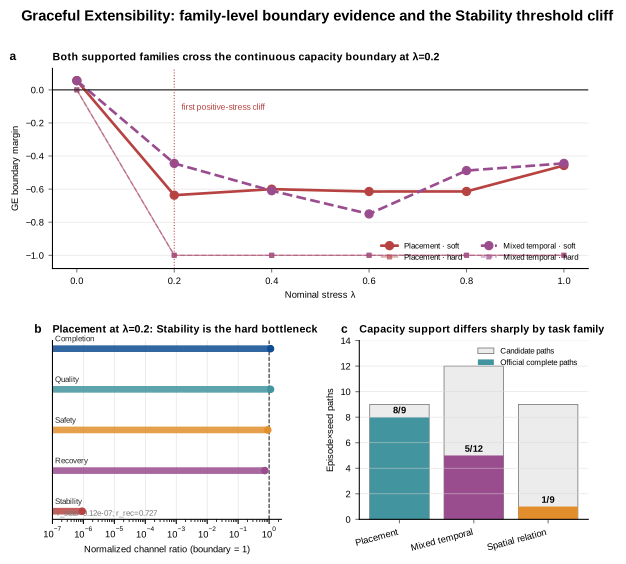
Graceful Extensibility maps complete episode×seed stress curves to task-family cells. Five channel ratios define the operational margin, and λ* records the longest continuously passing prefix from the clean reference at λ=0.
Eligible episode–seed curves form task-family stress cells; the complete family curve determines \(M_f(\lambda)\), \(\lambda_f^*\), and \(\mathrm{AUDC}_f\).
A ratio of \(1\) is the operational boundary. The reported headline \(\lambda_f^*\) is the longest continuously passing soft-margin prefix from \(\lambda=0\); a later re-entry cannot extend it. Higher \(\lambda_f^*\) and \(\mathrm{AUDC}^{\mathrm{norm}}_f\) indicate greater capacity. The statistical unit is one task-family stress cell, aggregated from eligible episode–seed paths.
Five channels
PC: task completion; Q: proposition satisfaction; Safety: safety burden; Rebound: recovery cost; Stability: formal perturbation sensitivity. The two weakest channels determine the soft margin, and the weakest channel determines the hard margin.
ALL TEN EPISODES
Eligible episode–seed paths
Official paths require six shared stress rows; strict paths also require valid critic-lifecycle and reward-shaper evidence at all six levels.
Strict: included in official and strict estimatesOfficial only: included in the official estimateExcluded: omitted from the estimator
Official and strict support status for 30 candidate episode×seed paths across 10 episodes
Family
Episode
Seed 0
Seed 1
Seed 2
Official
Strict
Placement
75
Strict
Strict
Excluded
2/3
2/3
78
Strict
Official only
Strict
3/3
2/3
98
Strict
Strict
Strict
3/3
3/3
Mixed
239
Excluded
Strict
Strict
2/3
2/3
258
Excluded
Strict
Excluded
1/3
1/3
290
Strict
Excluded
Strict
2/3
2/3
304
Excluded
Excluded
Excluded
0/3
0/3
Spatial
131
Excluded
Excluded
Excluded
0/3
0/3
144
Excluded
Excluded
Strict
1/3
1/3
174
Excluded
Excluded
Excluded
0/3
0/3
Denominator definition: Among 30 candidate paths, official shared-complete=14 (Placement 8 + Mixed 5 + Spatial 1) and strict-complete=13. The single complete Spatial path remains in the support audit; its clean reference has n=1<min_samples=2, so its family cells remain N/A. Operative support for estimable families is therefore 13 official paths and 12 strict paths.
OFFICIAL BOUNDARY
First stress boundary
Placement and Mixed first fail at \(\lambda=.2\); Spatial remains N/A because its clean reference has \(n=1<2\).
Fig. G1 | Family-level Graceful Extensibility under the six-level stress sweep.a, Placement and Mixed soft and hard margins, with the first cliff at λ=.2; b, five-channel Placement ratios at λ=.2 on a logarithmic x-axis, identifying Stability as the hard bottleneck and Rebound as the second-weakest channel; c, official-complete episode×seed support, including Spatial at 1/9 paths and capacity N/A. The curves are provisional family estimates under the reported support and threshold calibration.
Placement covers eight official-complete paths across Episodes 75, 78, and 98. At λ=0, the soft margin is +0.0556. At λ=.2, rPC=rQ=1.111, while rstab=9.12×10⁻⁷ and rrec=0.727 reduce the soft margin to −0.6367 and the hard margin to approximately −1.
Image evidence boundary The ImageGen panel communicates the conceptual geometry of five channels sharing a boundary while the weakest channel contracts early. Numerical claims derive from GE cells and support CSV files.
OFFICIAL SUPPORT8 / 9
STRICT SUPPORT7 / 9
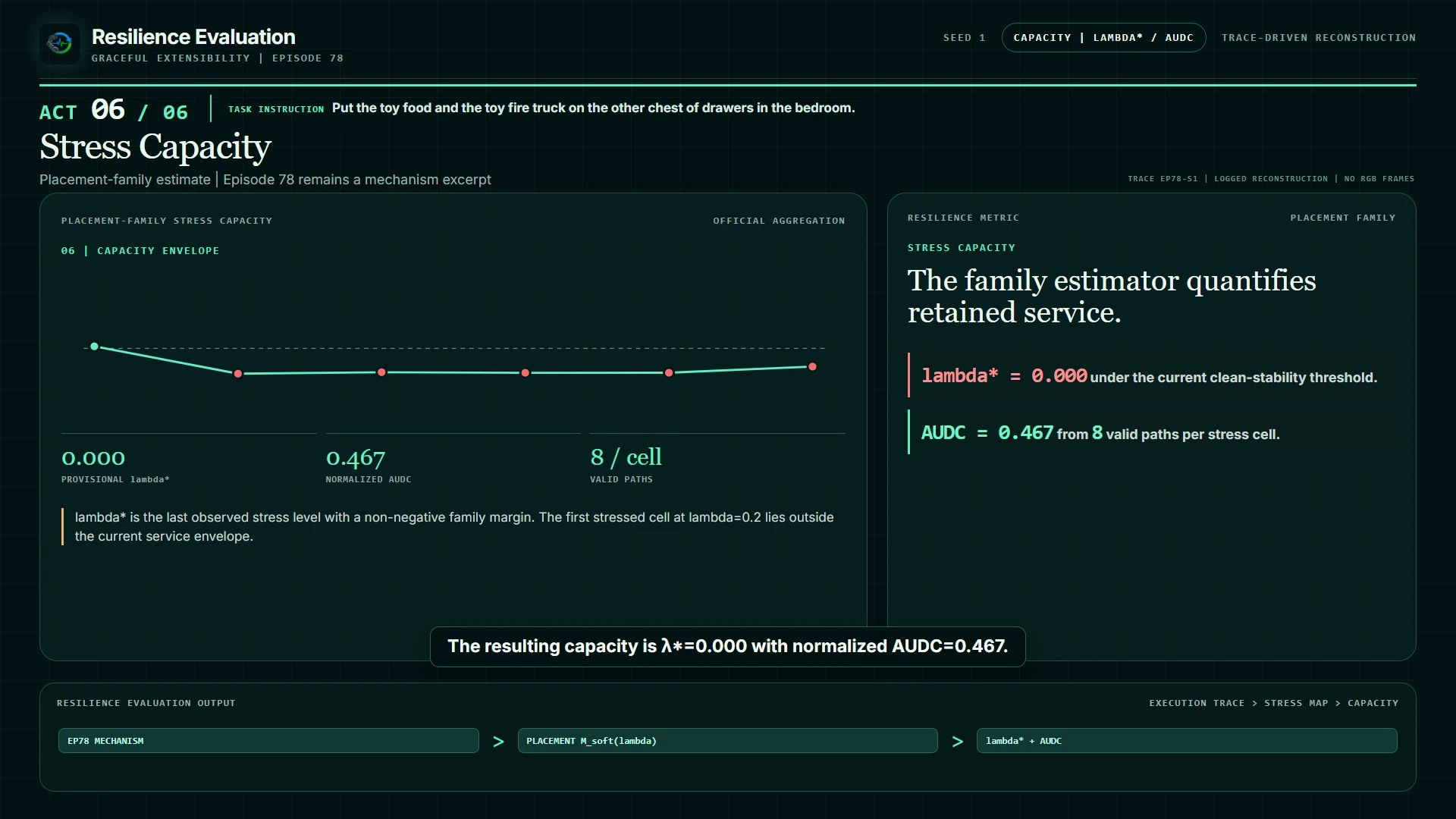
AUDC0.467
FIRST CLIFF0.2
ENGLISH ASPECT VIDEO · EVIDENCE-ALIGNED
Episode 78 at the boundary
This trace-driven reconstruction compares Episode 78 / seed 1 clean and λ=.2 contributing rollouts. Msoft, λ*, and normalized AUDC remain Placement-family summaries (n=8 per cell; 8/9 complete paths), and λ*=0 is interpreted as a provisional threshold-calibration diagnostic.
This trace-driven reconstruction compares Episode 78 / seed 1 clean and λ=.2 contributing rollouts. Msoft, λ*, and normalized AUDC remain Placement-family summaries (n=8 per cell; 8/9 complete paths), and λ*=0 is interpreted as a provisional threshold-calibration diagnostic.
TRACE-LEVEL CASE STUDY
Boundary and trajectory evidence
The trajectory browser applies two fixed comparisons to all 180 candidate runs. The longitudinal analysis follows Episode 78 / seed 1 across six stress levels, and the cross-sectional analysis holds seed 1 / λ=1.0 constant across episodes. GE capacity remains a task-family aggregate.
GRACEFUL EXTENSIBILITY · TWO-LEVEL EVIDENCE
From cells to planning nodes
Each panel reports the family-level margin alongside single-run simulation fields. Trajectories explain channel mechanisms, and capacity is aggregated from the complete eligible stress curves for that family.
LONGITUDINAL COMPARISON
Episode 78 stress trajectories
Six independent rollouts hold episode, seed, task contract, Planner, and Judge settings fixed.
Placement Msoft(λ) is estimated from 8/9 official-complete episode×seed paths. Ep78 / seed 1 provides mechanism evidence; its Crec, β, and simulation fields remain rollout-level quantities.
The planner directs toy food and the toy fire truck to chest_of_drawers_37; both Rearrange calls return the five-parameter API requirement.
sim step 1–819Explore
Objects and target furniture resolved
Thought summary: explore bedroom_1, verify the object instances, and select chest_of_drawers_36 as the target.
sim step 973completion .5
Five-parameter Rearrange executes
Agent 0 places toy_food_1 successfully while Agent 1 continues the parallel transfer of toy_fire_truck_0.
sim step 1264success 1
All propositions satisfied
Both objects are on chest_of_drawers_36, with task completion=1.0.
PLANNING NODES · λ .2
First-cliff repair
sim step 0replan 1
Two incomplete Rearrange calls
The observation returns the five-parameter template while completion remains 0.
sim step 819–820replan 3–4
Object resolution and second API repair
Thought summary: after identifying toy_food_1 and toy_fire_truck_0, add the spatial relation and constraint parameters.
sim step 926completion .5
First object transferred
Agent 0 completes the five-argument Rearrange, placing toy_fire_truck_0 on the target furniture.
sim step 1307–1809nav / place failure
Navigation target and placement distance unmet
Agent 1 first reports an inaccessible target; Place then fails because of distance or occlusion, prompting an Explore → Navigate → Place recovery.
sim step 1898–1899success 1
Terminal state satisfied
Place succeeds for the second object and completion rises to 1.0.
PLANNING NODES · λ .4
High-sensitivity short rollout
sim step 0Explore×2
Exploration begins from an empty object list
The planner assigns both agents to explore bedroom_1.
sim step 522nav target failure
Furniture navigation target rejected
Agent 1 cannot resolve a reachable navigation target for chest_of_drawers_36.
sim step 680completion .5
Held-object state triggers reassignment
Agent 0 completes toy_food_1; the planner detects that Agent 1 holds toy_fire_truck_0 and switches to Navigate and Place.
sim step 817success 1
Placement completed
Completion reaches 1.0. This rollout has β=1.746, the highest of the six Ep78 / seed 1 points.
PLANNING NODES · λ .6
Clean execution shape reproduced after specification repair
sim step 0Explore
Object visibility established
The run first explores bedroom_1 and then directs both targets to chest_of_drawers_36.
sim step 819API rejection
Two-parameter Rearrange rejected
The observation supplies the complete API template, and the planner immediately adds relation and constraint fields.
sim step 973completion .5
Parallel repaired actions take effect
Agent 0 first reports successful execution while Agent 1 remains in progress.
sim step 1264success 1
Both objects completed
The execution shape closely matches clean, while the current family cell remains constrained by the Stability ratio.
PLANNING NODES · λ .8
From empty action assignment to the shortest successful rollout
sim step 0–287no action assigned
Initial plan remains at Wait
Both agents report “No actions were assigned,” and task progress remains 0.
sim step 288–426replan 3–5
Explicit navigation and five-parameter repair
The planner activates bedroom navigation and then submits complete Rearrange parameters in parallel.
sim step 426completion .5
First object completed
Agent 0 reports success while Agent 1 continues the second object.
sim step 758success 1
Shortest completion path
This level has the fewest simulation steps and Crec=8.968; the family margin remains constrained by the aggregated channels.
PLANNING NODES · λ 1
Stable completion under high stress with persistent boundary violation
sim step 0Explore
Object index recovered
The object list is initially empty, and the planner begins by exploring bedroom_1.
sim step 819API rejection
Two simplified Rearrange calls rejected
The system returns explicit requirements for spatial relation, furniture, and constraint fields.
sim step 973completion .5
Parallel execution after specification repair
Thought summary: set relation to on and explicitly fill the spatial constraint and reference object with None.
sim step 1264success 1
Completion and termination
Completion reaches 1.0 and simulation steps match clean; the Placement-family λ* remains 0.
CROSS-SECTIONAL COMPARISON
Fixed-stress episode comparison
Seven episodes share seed 1 and \(\lambda=1\); Episode 304 is the outcome-associated negative control.
At λ=1, Placement family Msoft=−.4571 and Mixed family Msoft=−.4444. Each trajectory supplies an execution mechanism; the shared family cell is repeated across member panels to make the inferential level explicit.
PLACEMENT · EP75
Concise parameter repair after perception refresh
step 0PerceptionScanTool
Object index refreshed
Thought summary: use a perception scan to locate stuffed_toy_0 and toy_vehicle_1.
step 779API rejection
Simplified Rearrange fails
The target couch_23 is resolved, while the call omits the spatial relation and constraint fields.
step 1016–1120success 1
Both objects placed
Complete Rearrange calls advance completion from 0 to .5 and then to 1.0.
PLACEMENT · EP78
Position of the longitudinal anchor at fixed λ
step 0Explore
Exploration from an empty object list
The run locates two toy objects and the target chest_of_drawers_36.
step 819–973API repair
Spatial parameters completed
The call is converted from a two-parameter form into a five-argument Rearrange.
step 1264success 1
Completion and termination
Both objects satisfy their placement propositions.
PLACEMENT · EP98
Three-object placement extends the simulation horizon
step 0–397Wait / no action
Objects initially absent
The planner cannot find the laptop, monitor stand, or credit card in the object list; navigation and exploration update the state.
step 1548completion .333
First object placed
After the Rearrange parameters are completed, laptop_0 reaches couch_11.
step 3632success 1
All three objects completed
laptop_0, monitor_stand_1, and credit_card_2 are all placed on couch_11.
MIXED · EP239
High recovery burden in multi-goal mixed-temporal execution
step 0Wait / Explore
Two cross-room goal groups decomposed
The task requires transferring three credit cards while placing a gaming console and canister on a bedroom bed.
step 1670Pick failure
Insufficient pick distance
Pick[credit_card_0] reports “not close enough”; the planner moves closer to chair_20 and retries.
step 1942completion .167
First card placed
After Navigate and Place succeed, execution proceeds to the remaining cards and bedroom objects.
step 4499success 1
Six propositions completed
Terminal relations are satisfied for the three cards, console, and canister.
MIXED · EP258
Two-stage transfer of a plant and saucer
step 0API rejection
Object instances and parameters unresolved
The initial simplified Rearrange calls for plant_0 / saucer_0 are rejected.
step 1140completion .2
Object instances corrected
Exploration identifies plant_saucer_1 and plant_container_0, which are first transferred to living-room table_10.
intermediatetemporal stage
Transition from living room to kitchen counter
The saucer is retained as the reference object to establish the next_to relation.
step 1463success 1
Two-stage task completed
Both objects are on counter_19 and adjacent to one another.
MIXED · EP290
Long execution trace with missing paired β
step 0–444API / object mismatch
Initial object name misalignment
Simplified calls for apple_0 and lamp_0 are rejected; exploration corrects the lamp instance to lamp_2.
step 1756completion .2
Intermediate office-table state completed
apple_0 and lamp_2 reach table_36, while toy_animal_1 remains on bed_16.
late stagenext_to repair
Transfer to the living-room bench
Alternating Pick, Navigate, and Place actions establish adjacency between the apple and lamp.
step 4158success 1
Terminal propositions completed
Both transferred objects are on bench_10, and the toy animal remains on the bedroom bed.
MIXED · EP304 · NEGATIVE CONTROL
Planner termination claim diverges from task outcome
step 0API rejection
Simplified plant-transfer call fails
Rearrange[plant_0, bench_10] omits the spatial relation and object-instance information.
step 1128–1323completion .25
First-stage plant transfer succeeds
The instance is corrected to plant_container_0 and placed on table_30 after the on relation is supplied.
late stagethree subgoals
Cushion and toy vehicle continue
The planner records execution of three subgoals, while the Judge retains one unsatisfied proposition.
step 3067success 0
Termination at completion .75
The planner trace declares completion with task_state_success=0; Crec and paired β are both N/A.
For \(\lambda>0\) and \(\beta(\lambda)>0\), \(r_{\mathrm{stab}}\) contracts to approximately \(10^{-6}\)–\(10^{-5}\), yielding \(M_f^{\mathrm{hard}}\approx-1\). The observed \(\lambda^*=0\) is therefore a threshold-calibration diagnostic; estimating system perturbation capacity requires an independently calibrated Stability threshold.
Family-specific secondary bottlenecks
Placement is principally constrained by Rebound at λ=.2/.6/.8 and by Safety at λ=.4/1.0. For Mixed at λ=.6, Rebound ratio=0.500 yields the deepest soft margin, −0.750. At other stress levels, the second bottleneck shifts among Safety, Rebound, and PC/Q.
MECHANISM-RICH FAMILY CONTRAST
Mixed-family comparison
Mixed \(\lambda^*=0\) uses 5/12 official paths across Episodes 239, 258, and 290; Episode 304 remains an excluded negative control.
Mixed official curve
At λ=0, the soft margin is +0.0556; at λ=.2 it declines to −0.4444. At λ=.6, rrec=0.500 and a near-zero rstab produce the curve’s deepest soft margin, −0.7501. AUDC=0.5027 indicates slightly greater integrated retention over the current support set than Placement; both families retain λ*=0.
Episode 304 negative control
task_state_success=0/18; mean completion=0.6667, with 16/18 runs at 0.75 and 2/18 at 0; Crec valid=0/18. Its exclusion from the Mixed estimator demonstrates the support-selection dependence of PC/Q=1.111 in complete-pair cells.
SUPPORTING TRAJECTORIES
Prespecified mechanism excerpts
Three strict-complete successful paths explain mechanisms while each family estimate retains every eligible path.
PRIMARY FAMILY MECHANISM
Placement · Ep78 / seed 0
λ=.2: Crec=25.454, β=1.408, unsafe=.0207, 1252 steps, success. Explore resolves the target and a two-agent Rearrange repair follows; terminal success co-occurs with a near-zero Stability ratio.
MIXED FIRST-CLIFF EXCERPT
Mixed · Ep239 / seed 2
λ=.2: Crec=18.113, β=1.151, unsafe=.0219, 2689 steps, success. A two-parameter Rearrange error is repaired; `next_to,None` then fails, followed by completion with a reference object.
MIXED REBOUND BOTTLENECK
Mixed · Ep258 / seed 1
λ=.6: Crec=75.256, β=.305, unsafe=.0253, 1702 steps, success. After repeated use of invalid `next_to,None`, the saucer is placed first and then used as the reference for the plant.
Mechanism-excerpt selection audit: fixed eligibility, target cell, and observable trace features
Report role
Path / cell
Eligibility
Quantitative anchor
Trace question
Estimator status
Placement first-cliff mechanism
Ep78 / seed 0 / λ=.2
Strict complete; success=1
β=1.408; Crec=25.454
How does success co-occur with the Stability cliff after parameter repair?
Excerpt only
Mixed first-cliff contrast
Ep239 / seed 2 / λ=.2
Strict complete; success=1
β=1.151; Crec=18.113
Does the same first-cliff cell contain an auditable error–repair sequence?
Excerpt only
Mixed Rebound bottleneck
Ep258 / seed 1 / λ=.6
Strict complete; success=1
family rrec=0.500; Crec=75.256
How does the second Rebound bottleneck accumulate across actions?
Excerpt only
The selection table can be verified against the case-selection audit CSV, trajectory-source CSV, and official family-cells CSV. Trajectory excerpts address how a channel mechanism can arise; family GE remains jointly estimated from all eligible episode×seed curves in the corresponding task family.
REPORTED FAMILY CELLS · ROUNDED
Channel ratios and margins
Ratios use the clean family reference; retained precision resolves \(M_f^{\mathrm{hard}}\) from \(-1\), and invalid Spatial placeholders are omitted.
Placement
λ
PC
Q
Safety
Rebound
Stability
M soft
M hard
0
1.111
1.111
1.250
1.250
1.000
+0.0556
0
.2
1.111
1.111
.903
.727
9.12e−7
−.6367
−.99999909
.4
1.111
1.111
.800
.857
5.97e−7
−.6002
−.99999940
.6
1.111
1.111
1.535
.771
2.95e−6
−.6144
−.99999705
.8
1.111
1.111
1.310
.772
1.55e−6
−.6140
−.99999845
1
1.111
1.111
1.086
1.321
4.45e−6
−.4571
−.99999555
Mixed temporal
λ
PC
Q
Safety
Rebound
Stability
M soft
M hard
0
1.111
1.111
1.250
1.250
1.000
+.0556
0
.2
1.111
1.111
2.000
1.875
8.69e−7
−.4444
−.99999913
.4
1.111
1.111
.781
2.000
1.93e−6
−.6096
−.99999807
.6
1.111
1.111
1.895
.500
3.28e−6
−.7501
−.99999672
.8
1.111
1.111
1.824
1.024
3.36e−6
−.4879
−.99999664
1
1.111
1.111
2.000
1.166
1.37e−5
−.4444
−.99998625
Spatial relation
Spatial relation official capacity = N/A; strict sensitivity = N/A. Episode 144 / seed 2 supplies the single official/strict-complete curve. The clean reference has n=1, below min_samples=2, rendering all six stress cells invalid. Exported zeros are invalid placeholders; ratios, margins, and λ* remain N/A.
ROBUSTNESS & LIMITATIONS
Inference tiers
Lifecycle-strict analysis narrows support while preserving the original rollouts, exclusions, and qualitative boundary test.
Official
Shared-complete=14; operative curves for estimable families=13. Placement AUDC=.4668 and λ*=0; Mixed AUDC=.5027 and λ*=0.
Lifecycle-strict
Shared-complete=13; operative curves for estimable families=12. Placement AUDC=.4763 and λ*=0, preserving the qualitative conclusion.
Without Stability
In this diagnostic, Mixed λ*=.2 and Placement remains 0. The preregistered formal GE retains the complete five-channel definition.
Required calibration
Independent clean–clean replication must estimate a nonzero noise floor; exact capacity can then be recomputed after preregistration of τstab.
Calibrated interpretation: Under the current degenerate threshold induced by clean β=0, formal GE structurally crosses the hard boundary at the first positive-stress cell. This provisional result primarily reflects threshold calibration; physical capacity requires independent calibration.