Here, \(\rho=10^{-3}\), \((\cdot)^{+}\) is the Moore–Penrose pseudoinverse, and \(\varepsilon=10^{-6}\). \(L\) is a rollout-level mean transition distance; \(\beta_{a,s}\) is an episode–seed clean–stress pair; \(\beta_a\) is an episode anchor; and \(\beta_f^{\mathrm{shared}}\) is a task-family shared-support summary. Lower \(\beta\) indicates greater Stability.
DEFINITION
Paired trajectory sensitivity
Each eligible transition uses \(x_t=[\Delta V_t,\delta_t,A_t,\Delta p_t,\Delta q_t,e_{\mathrm{plan},t}]\), measured against the episode-stage clean StageBaseline.
Aggregation hierarchy
Seed-local · (episode, seed, λ): stress L is paired exactly with clean L for the same seed.
Anchor · (episode, λ): the supremum is taken over eligible seeds Pa.
Family · (family): the supremum is taken over shared-support anchors Afshared.
Direction: lower β indicates lower sensitivity. N/A remains missing. Incomplete family coverage supports a diagnostic supremum.
FORMAL SUPPORT
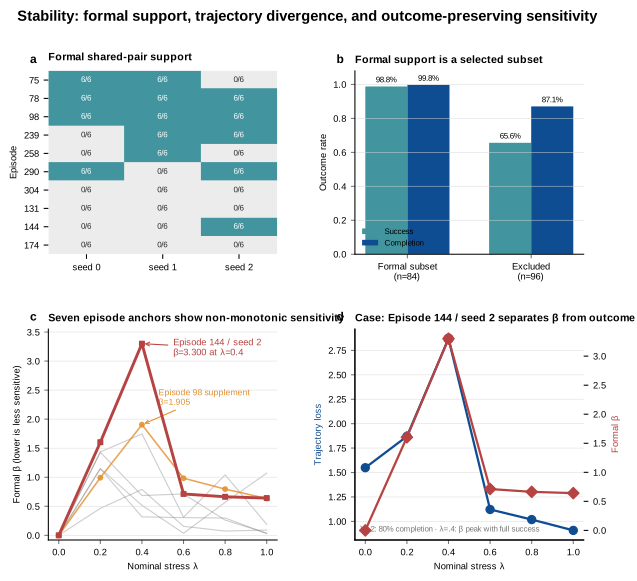
84 / 180 rows · 14 / 30 paths · 7 / 10 anchors
Formal support is outcome-associated. Eligible rows have success=98.8% and completion=99.8%, compared with 65.6% and 87.1% for excluded rows; the missing-completely-at-random assumption remains untested, so the 84 formal rows define a support-selected subset.
EPISODE ATLAS
Ten-episode support
β peak is the maximum of the anchor-level max-over-seed curve. Episodes without a complete formal pair remain N/A; any computable diagnostic β is retained in a separate diagnostic layer.
| Family | Episode | Shared rows | Complete pairs | β peak | Peak λ | Success | Completion |
|---|---|---|---|---|---|---|---|
| Placement | 75 | 12/18 | 2/3 | .790 | .4 | 100% | 100% |
| Placement | 78 | 18/18 | 3/3 | 1.746 | .4 | 100% | 100% |
| Placement | 98 | 18/18 | 3/3 | 1.905 | .4 | 100% | 100% |
| Spatial | 131 | 0/18 | 0/3 | — | — | 100% | 100% |
| Spatial | 144 | 6/18 | 1/3 | 3.300 | .4 | 66.7% | 92.2% |
| Spatial | 174 | 0/18 | 0/3 | — | — | 55.6% | 77.8% |
| Mixed | 239 | 12/18 | 2/3 | 1.151 | .2 | 100% | 100% |
| Mixed | 258 | 6/18 | 1/3 | 1.146 | .2 | 94.4% | 95.6% |
| Mixed | 290 | 12/18 | 2/3 | 1.430 | .2 | 94.4% | 97.8% |
| Mixed | 304 | 0/18 | 0/3 | — | — | 0% | 66.7% |
CASE SELECTION
Case-selection criteria
Tier A requires valid trajectory loss, shared β, and lifecycle evidence at all six stress levels. Eligible paths are ordered by outcome reversal, formal β peak, non-monotonicity, and trace-level mechanism; this selection supports mechanism analysis within the shared-support subset.
Primary · Episode 144 / seed 2
The only outcome reversal among 14 complete shared-support paths and the highest β in that formal subset, at 3.300. Completion is .8 at λ=.2; the λ=.4 rollout succeeds after a policy repair. The numerical claim is scoped to the formal subset.
Supplement · Episode 98 / seed 1
All six rollouts succeed. At λ=.4, the path records β=1.905, trajectory loss=1.493, and 19 replans. Success and Stability therefore remain separately reported.
Supplement · Episode 239 / seed 1
The mixed-temporal path exhibits a high-stress tail: at λ=1, β=1.070 and 33 centralized replans coexist with task completion, exposing family- and variant-level heterogeneity.
IMAGEGEN · MECHANISM ILLUSTRATION · TRACE-DRIVEN RECONSTRUCTIONPRIMARY CASE STUDY · EPISODE 144 / SEED 2
Peak deviation with success
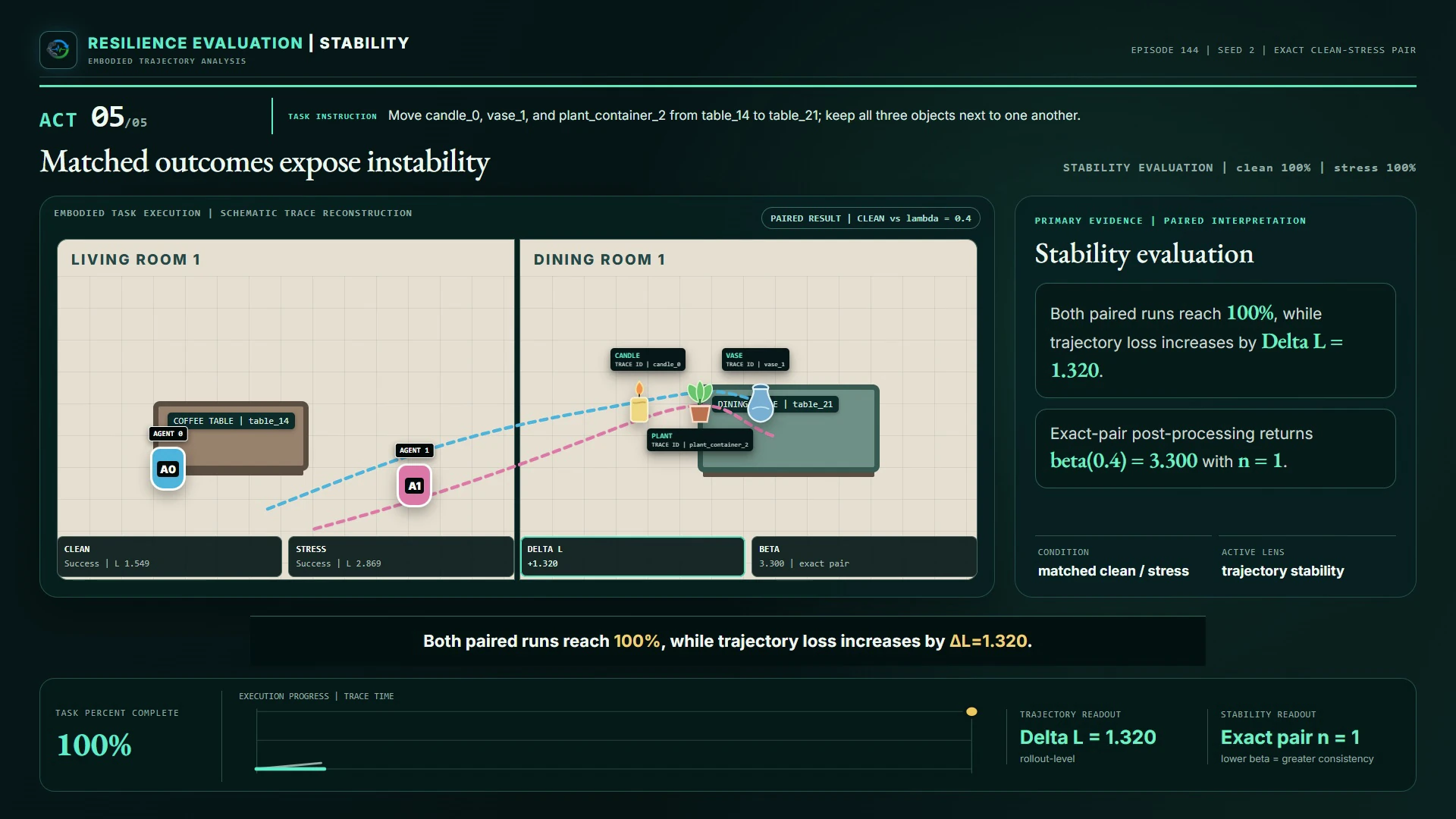
The task moves candle_0, vase_1, and plant_container_2 from coffee table table_14 to dining table table_21 and requires the three objects to be adjacent.
λ=.2: realized dose=.2, text dose=.2115, L=1.8700, and β=1.6034. The Planner terminates after interpreting table co-location as relation satisfaction; the Judge retains the missing vase_1 next_to plant_container_2 proposition, yielding success=0 and completion=.8.
λ=.4: realized dose=.4, text dose=.4231, L=2.8694, and β=3.3000. World-state evidence places vase_1 on floor_dining_room_1, after which rejected Rearrange calls lead to an explicit Pick → Place repair and success=1 with completion=1.0.
β measures normalized divergence from the observed clean trajectory. Absolute distance from an ideal policy lies outside the metric definition. The ImageGen asset encodes the mechanism; quantitative evidence comes from the trace, critic export, and CSV records.
ENGLISH ASPECT VIDEO · EVIDENCE-ALIGNED
Episode 144 at \(\lambda=.4\)
This trace-driven reconstruction compares the matched clean and λ=.4 executions for Episode 144 / seed 2. Five planning-state nodes expose the internal 100%→60%→100% rollback; β=3.300 is the exact-pair estimate with n=1.
INTERACTIVE TRAJECTORY ATLAS
Longitudinal and cross-sectional evidence
The atlas applies two fixed comparisons to all 180 candidate rollouts. The longitudinal view follows Episode 144 / seed 2 across six independent stress levels; the cross-sectional view holds seed 2 and λ=.4 constant, comparing five episodes with formal β and Episode 258 as an outcome control with missing β.
REPRESENTATIVE EXECUTION · FORMAL PAIR SUPPORT
From \(\beta\) to planning nodes
Each panel links the task contract, trace-grounded Thought, Action, simulator response, \(L\), \(\beta\), and outcome.
LONGITUDINAL COMPARISON
Episode 144 stress trajectories
Six independent rollouts hold episode, seed, task contract, Planner, Judge, and configuration fixed.
- Aspect
- Stability · trajectory sensitivity
- Episode / seed
- 144 / 2
- Family
- spatial_relation
- Formal support
- 6/6 loss · 6/6 β valid
Clean: API repair
- Task parsing and empty-action feedback
The Planner identifies the three objects and dining-table goal. Its first response assigns no action, and the tool response requests an explicit assignment.
- Exploration, entity localization, and syntax repair
Explore[living_room_1] maps table_14 to the source and table_21 to the target. After the Rearrange arguments are completed, candle_0 and vase_1 are transferred in sequence.
- Plant placement and termination
plant_container_2 reaches table_21, proposition satisfaction moves from .8 to 1.0, and the Judge records success=1.
\(\lambda=.2\): unresolved relation
- Exploration and three-object localization
Explore[living_room_1] locates plant_container_2, vase_1, and candle_0; table_21 is identified as the target furniture.
- Rearrange argument repair and sequential transfer
The tool response identifies the missing spatial relation. The Planner adds on/table_21 and transfers the plant and vase.
- Position propositions pass; next_to remains unsatisfied
After candle_0 reaches the table, the Planner terminates. The Judge records completion=.8 and success=0 because vase_1 next_to plant_container_2 remains unsatisfied.
\(\lambda=.4\): rollback repair
- Parallel exploration of the living and dining rooms
The two agents localize the source objects and target furniture and construct a parallel plan for candle_0, plant_container_2, and vase_1.
- Two Rearrange calls fail schema validation
Both actions omit the spatial relation. The Planner adds on/table_21 and supplies next_to references for subsequent objects.
- World-state evidence retracts an apparent success
Progress briefly reaches 1.0, then an observation places vase_1 on floor_dining_room_1 and completion returns to .6.
- Explicit Pick → Place repair
The Planner executes Pick[vase_1], followed by Place[vase_1, on, table_21, next_to, plant_container_2]. Success returns to 1.
- Relation verification and termination
All three objects are on table_21 and the adjacency proposition is satisfied, yielding Judge completion=1.0.
\(\lambda=.6\): direct convergence
- Exploration and entity localization
Additional scene context leaves the task contract unchanged. Explore supplies the exact object identifiers.
- Argument repair after empty-action and API feedback
The Planner completes Rearrange[object, on, table_21, …] for both agents; candle_0 and vase_1 finish first.
- Plant placement completes the task
The final action succeeds, and completion and proposition satisfaction reach 1.0 together.
\(\lambda=.8\): constraint repair
- Abstract entity names fail schema validation
Rearrange[candle, table_21] and Rearrange[vase, table_21] lack exact entities and complete arguments.
- Exploration establishes a valid reference chain
The Planner identifies candle_0, vase_1, and plant_container_2 and binds each next_to constraint to a valid reference object.
- The adjacency chain completes
plant_container_2 is placed next to vase_1; position and relation propositions reach completion=1.0.
\(\lambda=1\): longer exploration
- Multi-room exploration restores object evidence
The Planner explores the living room, dining room, kitchen, bedroom, and closet. The world update at sim 3560 finally identifies the three objects on table_14.
- Two argument errors precede a valid adjacency chain
After the Rearrange schema is completed, candle_0 reaches table_21 and vase_1 uses candle_0 as its reference.
- Plant relation placement and termination
plant_container_2 is placed with vase_1 as the reference object, producing success=1.
CROSS-SECTIONAL COMPARISON
Fixed-stress episode comparison
At seed 2 and \(\lambda=.4\), five episodes have formal \(L\) and \(\beta\); Episode 258 is an outcome-zero control with \(\beta=\mathrm{N/A}\).
- Fixed seed
- 2
- Fixed stress
- λ=.4
- Formal candidates
- 5 episodes
- Boundary control
- Ep258 · β N/A
Parallel two-object transfer
- Initial entity assumptions and API rejection
The Planner constructs Rearrange calls directly; the tool response requests complete arguments and exact entity names.
- Two-room exploration corrects the target furniture
Explore locates toy_fire_truck_0, toy_food_1, and target chest_of_drawers_37; the two agents execute in parallel.
- Asynchronous completion and termination
The fire truck arrives first, toy food follows, and completion reaches 1.0.
Long-horizon action cycles
- Empty actions, distance errors, and Place argument errors
The Planner stalls when object evidence is incomplete. A laptop Pick fails on distance, followed by Place failures from incomplete arguments and target distance.
- Explicit navigation enables object-wise transfer
Each object follows an office table → Pick → living room → Place loop. The laptop and monitor stand arrive first.
- The credit card completes the third loop
The final Place advances completion from .667 to 1.0.
Spatial rollback repair
- Dual-agent exploration and action-schema repair
The source table, target table, and three objects are bound to exact entities.
- The vase floor state triggers a progress rollback
A world update moves completion from 1.0 back to .6.
- Pick/Place completes the relation repair
vase_1 returns to table_21 next_to plant_container_2.
Sequential reference dependency
- Object-set exploration after the initial API rejection
The Planner identifies three credit cards, a gaming console, and a canister while preserving the cards-first, bedroom-objects-second order.
- Three credit cards complete the first stage
The cards are placed on chest_of_drawers_56 in sequence, bringing completion to .5.
- An unavailable reference object causes placement failure
The next_to constraint fails while canister_4 remains unplaced. The Planner places the console first and then places the canister next_to it.
Intermediate-goal rollback
- Two-room exploration and Rearrange schema repair
apple_0 and lamp_2 are moved to the office table first, while toy_animal_1 remains on the bed.
- Reference availability and held-object conflicts
Repeated lamp next_to apple placement failures produce plan rollback between the office table and living-room bench states.
- Place resolves the held-object state
Place[lamp_2, on, bench_10, next_to, apple_0] succeeds, bringing completion to 1.0.
Termination–outcome divergence
- Empty actions, abstract entity names, and API errors
The Planner omits actions twice and then uses abstract plant/saucer names. Tool feedback directs navigation to the bedroom and supplies exact entities.
- Partial progress through the ordered goals
plant_saucer_1 moves first to the living-room table and then to the kitchen counter; the intermediate state of plant_container_0 leaves the full sequential contract unsatisfied.
- Planner Done and Judge failure
The visible Thought claims task completion. The Judge records completion=.2 and success=0, and formal β support is absent.